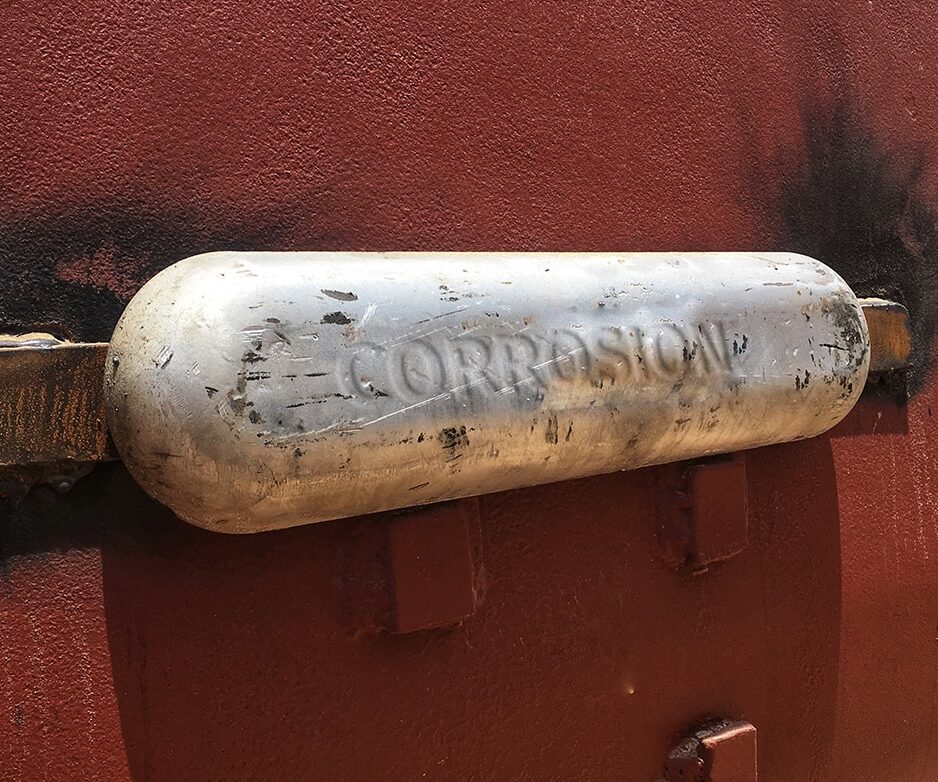
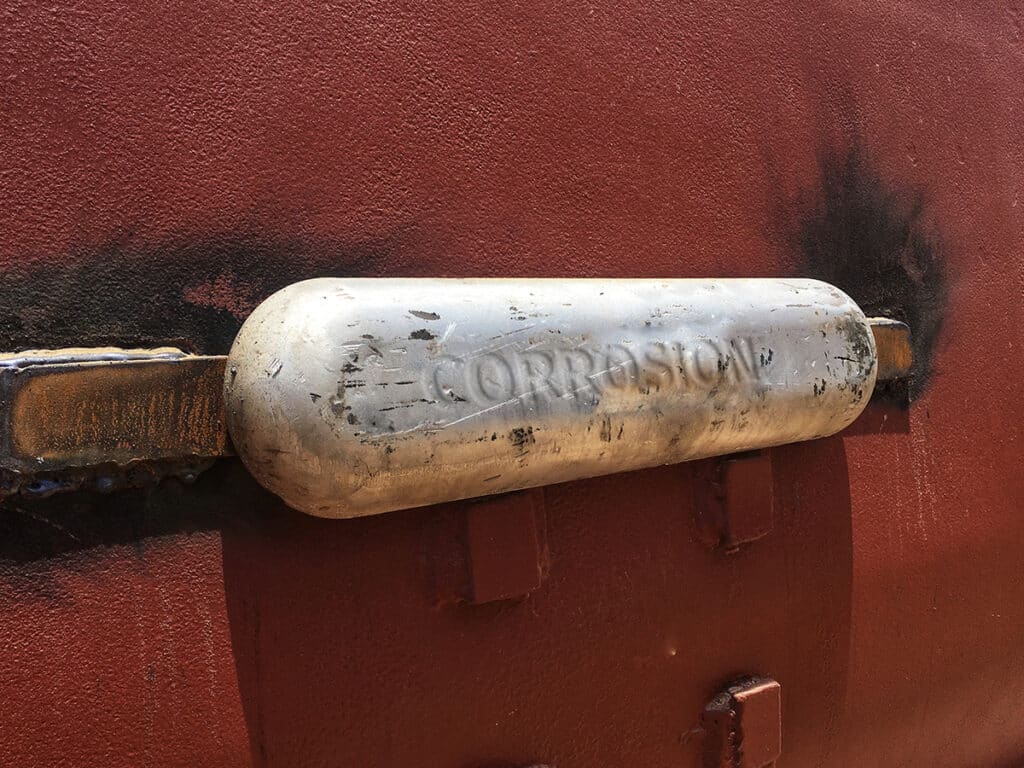



While we are continually developing more effective and sustainable products and services, CORROSION also supplies a number of traditional cathodic protection solutions, such as sacrificial anodes for ships.
Galvanic marine sacrificial anodes have been utilized for over 100 years to protect marine structures. Cast with high-efficiency alloys, sacrificial anodes are lightweight and have a high amperage output.
Our anodes function economically and efficiently without any maintenance during the operating period. For this reason, they do not lead to additional labor costs post-installation.
What’s more, as a sacrificial anode supplier we are able to supply these anodes for ships in conjunction with Impressed Current Cathodic Protection (ICCP) systems.
As sacrificial anodes are cast with high-efficiency alloys, they are lightweight, have a high amperage output and can function economically and efficiently without any maintenance throughout the operating period or need of an external power source. That means no added labor costs or extra electrical supply post-installation.
“Our marine sacrificial anodes stand the test of time. And with over 25 years of experience as a sacrificial anode supplier, we know all about high performance and durability.”
As one of the international sacrificial anode suppliers, CORROSION offers one of the largest and most varied ranges of sacrificial anode cathodic protection systems available, from standard to custom-made anodes. This means that our experienced Marine and Corrosion Engineering Team are able to meet any customer demand, with anodes of any size, weight or shape.
Today our marine sacrificial anodes are used to protect:
To learn more about Sacrificial Anode and Cathodic Protection (SACP), please click here.
Material that is less noble than iron in a seawater environment, such as magnesium, aluminum and zinc, will sacrifice itself to protect the nobler iron
Sacrificial protection is a passive method which exploits the natural tendency of a more reactive metal to become the anode when connected to a more noble metal. Cathodic protection employs inert anodes that could even be cathodic to the protected structure but are turned into anodes by an external source of current.
The required ampere is calculated by taking into account the lifespan and load of the coating layer of the steel to be protected. Depending on which anodes are to be used, the distribution and weight per anode are then determined.


DOWNLOAD
Whitepaper ICCP vs GACP
| Cookie | Duration | Description |
|---|---|---|
| cookielawinfo-checkbox-analytics | 11 months | This cookie is set by GDPR Cookie Consent plugin. The cookie is used to store the user consent for the cookies in the category "Analytics". |
| cookielawinfo-checkbox-functional | 11 months | The cookie is set by GDPR cookie consent to record the user consent for the cookies in the category "Functional". |
| cookielawinfo-checkbox-necessary | 11 months | This cookie is set by GDPR Cookie Consent plugin. The cookies is used to store the user consent for the cookies in the category "Necessary". |
| cookielawinfo-checkbox-others | 11 months | This cookie is set by GDPR Cookie Consent plugin. The cookie is used to store the user consent for the cookies in the category "Other. |
| cookielawinfo-checkbox-performance | 11 months | This cookie is set by GDPR Cookie Consent plugin. The cookie is used to store the user consent for the cookies in the category "Performance". |
| viewed_cookie_policy | 11 months | The cookie is set by the GDPR Cookie Consent plugin and is used to store whether or not user has consented to the use of cookies. It does not store any personal data. |